| Our Lady of Guadalupe | |
|---|---|
 |
|
| Feast Day | |
| Patron | Mexico, Americas, The Unborn |
Invoked as Star of the Evangelization of Peoples, comforter of indigenous people and the poor, the faithful humbly implore her help on the Tepeyac Hill in Mexico. She is Our Lady of Guadalupe, often called the "great missionary" who brought the Gospel to the Americas.
Origin
In 1531, the Blessed Virgin Mary appeared to Juan Diego, an Aztec who converted to Christianity. At that time Mexico was shaken by violence and continuous violations of human rights and dignity. Indigenous people, in particular, suffered serious discrimination.
The Marian apparitions consolidated the encounter between the indigenous peoples and Christ. Mary presented herself as the "Mother of the true God" and she chose Juan Diego to be her messenger. In fact, he reported that Our Lady told him to build a sanctuary at the place he had seen her. The bishop refused to believe him. Then, on December 12th, 1531, in midwinter, Our Lady caused fragrant roses to grow on that spot. Juan Diego collected the flowers in his cloak. When he opened the cloak, the image of Mary on the fabric appeared before the bishop. She is portrayed as a young indigenous woman, which is why the faithful still call her the "Virgen morenita" (the “Brown Virgin”).
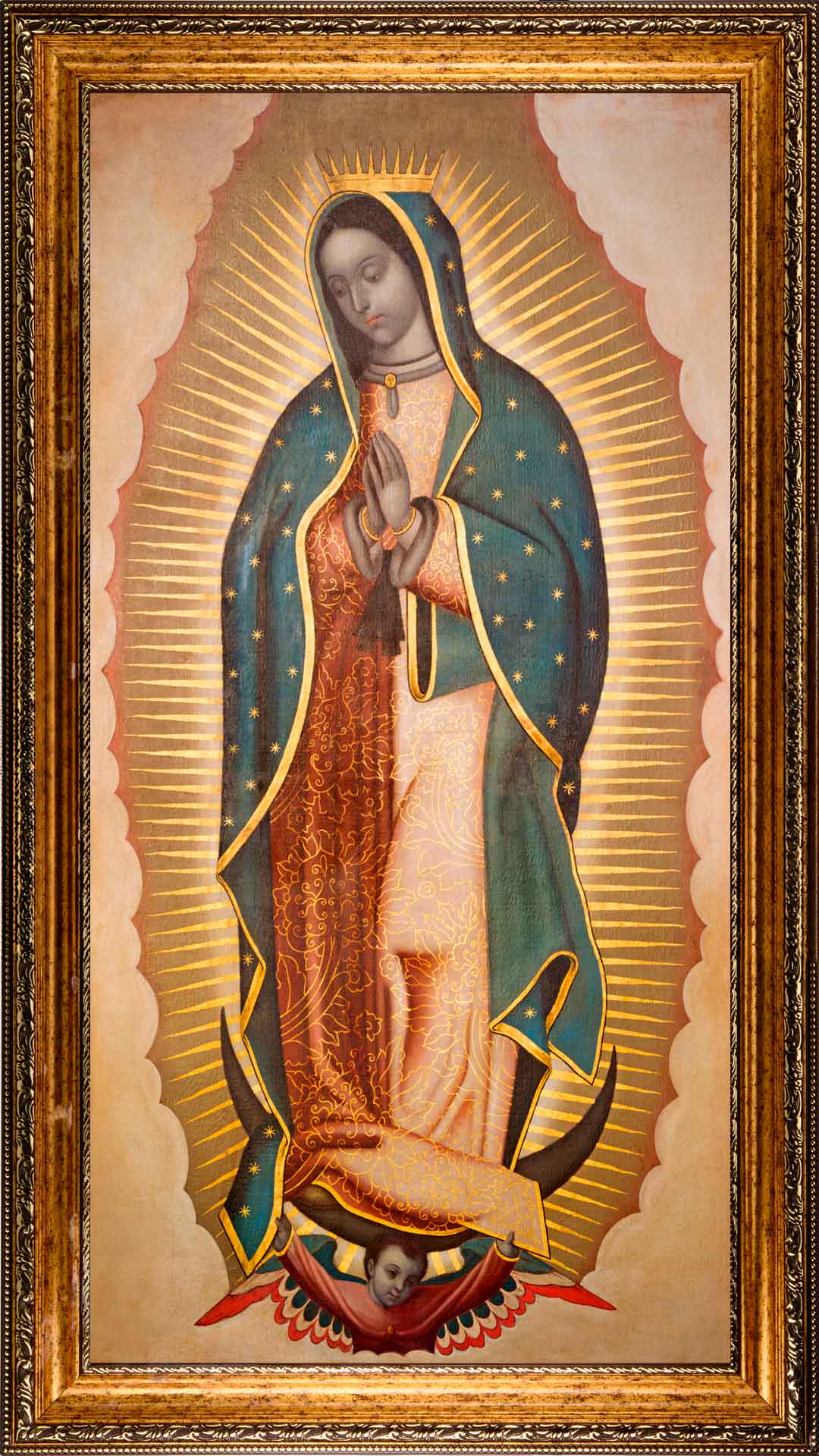
The tilma, or mantle, is made from coarse fibers of the Manguey cactus, used in Mexico by indigenous people to make clothing. The Virgin has a dark complexion and wears a pink tunic. She is surrounded by rays of the sun and stands on the moon. An angel appears at her feet. [1]
Miracles and Testimonies
- Undecayed Tilma - The tilma is made of ayate fiber (agave), which normally disintegrates within 10–20 years. It has survived in perfect condition for over 490 years, despite exposure to smoke, candles, and, in 1921, a bombing that destroyed the altar but left the glass-protected image unharmed.
- Non-Human Origin - Scientific analysis has failed to identify the technique or pigments used, noting the image appears to have no brush strokes.
- Reflections in the Eyes - Ophthalmological studies suggest that the pupils of the Virgin's eyes reflect the images of those present at the moment of the image’s revelation in 1531.
- Astronomical Alignment - The stars on the Virgin's mantle correspond to the exact configuration of the sky over Mexico City on December 12, 1531.
- Healing of Juan Bernardino - Mary appeared to Juan Diego's dying uncle, curing him instantly and identifying herself as "Our Lady of Guadalupe".
Devotion
In the image imprinted on the mantle, Mary's eyes reflect all the characteristics of the human eye. Extraordinary details are reflected in her eyes, images that are so small they have to be magnified up to two thousand times in order to identify them. An indigenous family group appears in the right eye: they are a woman with a child on her shoulder and a man in a hat that looks like a sombrero. In the left eye appears an elderly man with a beard, identified as the bishop. It is as though this is what Mary would have seen through her eyes at the moment Juan Diego opened his cloak in front of the bishop and the Marian image was revealed for the first time.
Mary turns her gaze upon the oppressed and suffering, in particular. Every year, millions of pilgrims visit the shrine of Our Lady of Guadalupe in Mexico where the mantle (tilmàtli) is kept. Juan Diego was proclaimed a saint on July 31st, 2002, by Pope Saint John Paul II and the present Basilica was built in 1976. [1]
Legacy
Christian tradition recognizes the Blessed Virgin Mary as “the mother of love,” Pope Leo said in his homily for the Feast of Our Lady of Guadalupe.
“In the Gospel,” he continued, “we hear how Mary lives the dynamic of one who allows the world to enter her life and transform it.” Filled with joy at the Annunciation, Mary throughout her life “brings joy to places where human joy is insufficient.”
This, the Pope said, is what happens in Guadalupe, where Mary “awakens in the inhabitants of America the joy of knowing themselves loved by God.” Noting that the Virgin spoke to St Juan Diego in his mother tongue, Pope Leo said that “in the midst of ongoing conflicts, injustices, and sufferings that seek relief, Our Lady of Guadalupe proclaims the core of her message: ‘Am I not here, I who am your mother?’” Mary, he continued, “is the voice that makes the promise of divine faithfulness resound, the sustaining presence when life becomes unbearable.”
As our Mother, Mary tells us to “do whatever Jesus tells us,” and we, in return, respond, “Yes, Mother, we want to be your true children. Tell us how to advance in faith when our strength wanes, and shadows grow. Help us to understand that with you, even winter becomes a time of roses.” [2]