| Saint Augustine | |
|---|---|
 |
|
| Birth | Nov 13, 354. Thagaste |
| Death | Aug 28, 430. Ruins of Hippo, Annaba, Algeria |
| Feast Day | |
| Patron | Theologians, Brewers, Printers, Philosophers |
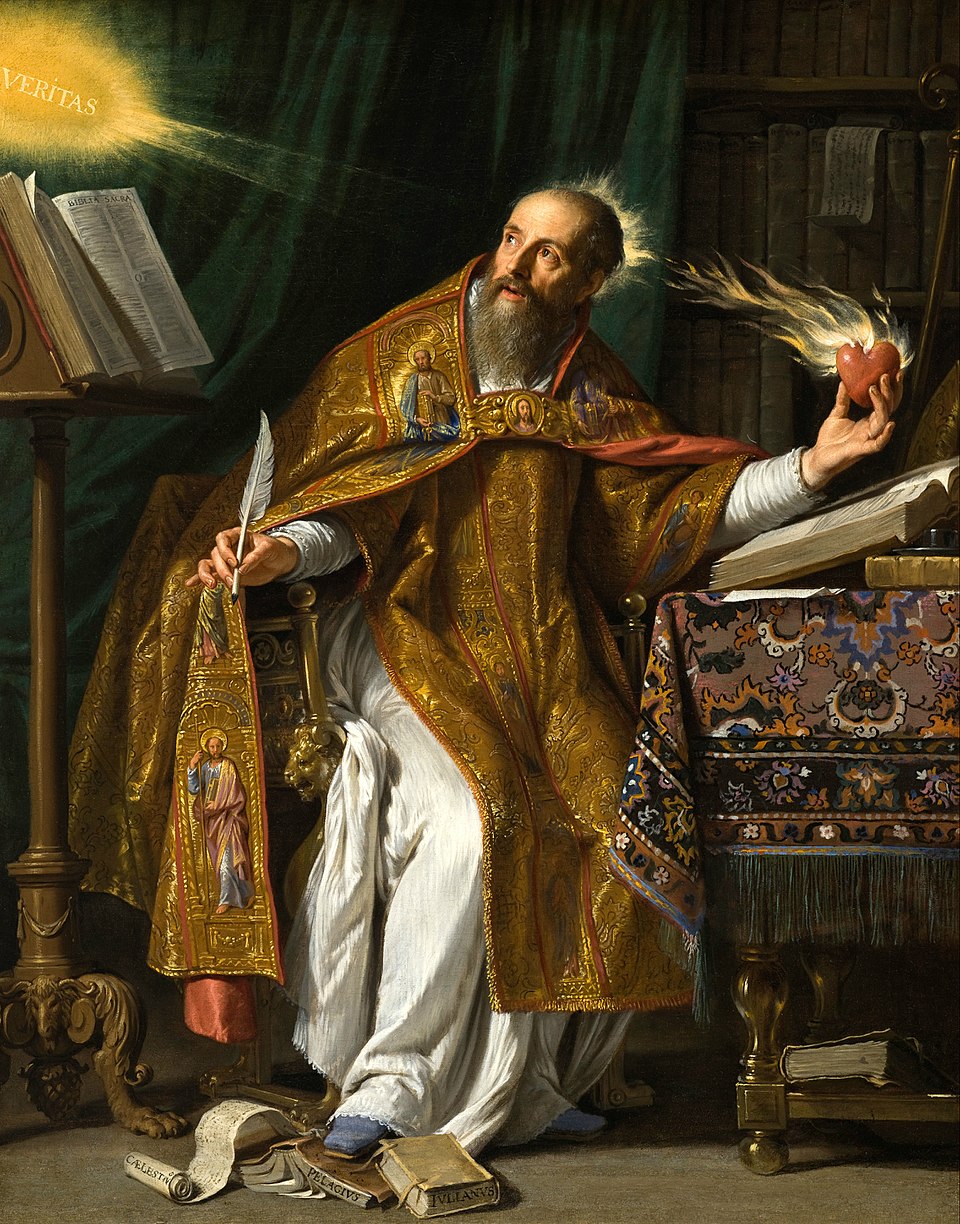
St. Augustine of Hippo, Bishop and Doctor of the Church, was an indefatigable truth-seeker. The author of hundreds of books, tracts, treatises and letters. He was born in Thagaste on November 13, AD 354, and died in the city of Hippo (present-day Annaba in Algeria), on August 28, AD 430.
Personal Life
Augustine’s mother, St. Monica, reared him in the Catholic faith, but he did not follow her example. A lively, witty and exuberant teenager, Augustine undertook the study of rhetoric, giving brilliant performance and showing enormous promise. He loved life and its pleasures, displayed a profound gift for friendship, experienced passionate love, adored the theater, sought fun and entertainment. In Carthage, where he went to study, he fell in love with a girl. Since she was of a lower social class, he took her as his concubine, but did not marry. They had a son, Adeodatus (whose name means “God-given”). Augustine, a father at 19, remained faithful to his common-law wife and took responsibility for the “family” ménage. On reading Cicero's Hortensius, Augustine’s whole way of seeing the world experienced a change. Happiness, Cicero taught him, consists of things that do not perish: wisdom, truth, virtue. Augustine decided to dedicate his whole life to their pursuit.
Having been reared in a Christian house, Augustine turned first to the Bible. He was not prepared to receive the wisdom of Sacred Scripture, however, and found holy writ gross and illogical. He then joined the sect of the Manichees (a group dedicated to a basically dualistic form of eclectic esoterism). Returning to Thagaste, he opened a school of “grammar” and rhetoric with the help of a benefactor, but the life he led did not please him, so he returned to Carthage with hope for a better future there. He continued to be dissatisfied. His thirst for truth was not slaked by the Manichaean doctrine. The young and promising rhetor went in search of new shores, and in 382, he moved to Rome with his companion and son, without informing his mother, who who had reached Carthage in the meantime. In the Imperial city, however, Augustine maintained his contacts with the Manichaeans, from whom he received financial support and encouragement. Later, he would come to understand that Providence also operates in one’s wrong choices. His career began to advance full-sail, and in 384 he earned the chair of rhetoric in Milan. Nevertheless, his inner turmoil continued to torment him.
Augustine’s ambition is satiated at Milan, but his heart continued restless. To refine his ars oratoria, he listened to the sermons of Bishop Ambrose. He wanted to overwhelm Ambrose’s dialectics, and instead the words of the Bishop touched him to the quick. Meanwhile, his mother Monica came to join him in Milan, and she accompanied him with her prayers. Augustine grew ever closer to the Catholic Church, and entered the catechumenate. Desiring a Christian wife, he sent his concubine to Africa. Still troubled, Augustine devoured philosophical texts and plunged into Sacred Scripture. Tempted by the experience of Greek thinkers, and attracted to the lifestyle of Christian ascetics, he cannot make up his mind. One day in August, 386, disoriented and confused, weeping in a garden, he seemed to hear a voice: Tolle! Lege! (which means, “Pick it up and read”). He considered the voice an invitation to turn to Paul’s letters, a copy of which was on a nearby table, and opened them at random. “"Let's trade honestly, as in the daytime, not in the midst of orgies and drunkenness, not among lusts and impurities, not in litigation and jealousy. Put on the Lord Jesus Christ instead of letting go of the fleshly desires. (Rm 13, 13-14)” The lines were decisive for him. He decided to change his life and to devote himself to God. He was baptized by Ambrose in the night between April 24 and 25, 387, and wishing to return to Africa, travels to Rome to embark from the port city, Ostia, where his mother, Monica, died before taking ship.
Augustine founded his first community in his hometown, Thagaste. Between the end of 390 and the beginning of 391, he found himself perchance in Hippo, in the basilica where Bishop Valerius was talking to his faithful about the need for a priest in his diocese. Alerted to his presence among them, the congregation pushes Augustine to the fore, and insists that Valerius ordain him. Though he had been convinced of his calling to live in a vowed religious state, Augustine, studying and meditating on the Scriptures, came to understand that God had else in store for him. He eventually became Bishop of Hippo, succeeding Valerius, and left countless writings behind, in which he carried forward his lifelong project of truth-seeking through faith and reason. [1]
Miracles and Testimonies
- Healing of a Blind Man in Milan (c. 386) - Augustine personally witnessed a blind man named Severus regain his sight after touching relics of martyrs Gervasius and Protasius.
- Healing of Innocentia of Carthage - A woman with breast cancer was instantly healed after making the sign of the cross on her breast.
- Healing of Innocentius - A former advocate, Innocentius, was cured of a rectal fistula (a severe, incurable case requiring surgery) through prayer.
- Healing of the Blind Woman (near Carthage) - A woman born blind was cured instantly after placing flowers that had been on the reliquary of St. Stephen on her eyes.
- Exorcisms - Several instances of demon possession being cured by prayers, oil, or the relics of saints.
- Healing during the Siege of Hippo (c. 430) - During the siege of his city, Augustine reported the healing of a man who was brought to him for the laying on of hands.
Legacy
“To be recognised as an Augustinian,” he said, “is an honour held dearly. So much of who I am I owe to the spirit and the teachings of Saint Augustine. I am grateful to all of you for the many ways your lives exhibit a deep commitment to the values of veritas, unitas, caritas.”, Pope Leo XIV
Reflecting on the saint’s life, Pope Leo noted that Augustine’s journey “was full of trial and error, like our own lives.” Yet through grace, the prayers of his mother Monica, and the witness of the community around him, he discovered “the way to peace for his restless heart.”
The Pope underlined that Augustine’s witness calls every Christian to recognize their God-given gifts and to offer them “in loving service to God and to our neighbour.” [2]