| Saint Ambrose | |
|---|---|
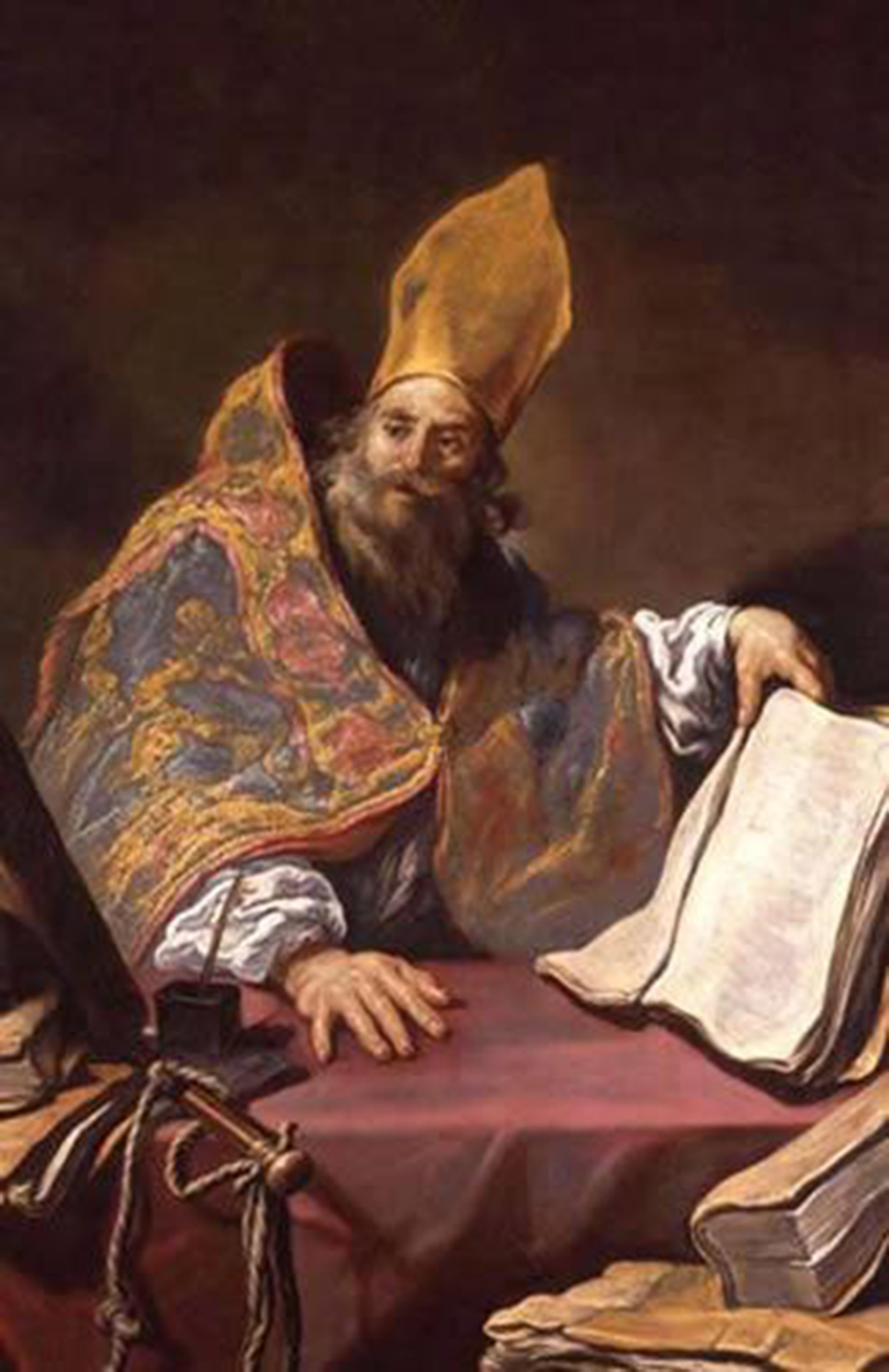 |
|
| Birth | 340 AD. Augusta Treverorum, Roman Empire |
| Death | Apr 4, 397. Milan, Italy |
| Feast Day | |
| Patron | Beekeepers, Bees, Candlemakers, Chandlers |
Among the great holy Doctors of the Western Church, Ambrose was Bishop of Milan, a writer of hymns, initiator of Mariology. He embodies the ideal of the pastor. Remembered by the Church on 7 December, he was the author of famous liturgical texts and inflexible against heresy.
Personal Life
These were times of lacerating social divisions. On 7 December 374 in a church in Milan the discussion had become animated. The thorny question of the naming of a new bishop of the city, capital of the Western Roman Empire, had exacerbated the rift between Catholics and Arians. The denial of the divinity of Christ, supported by the latter and opposed by the former, was perceived as an insurmountable barrier to the choice of a pastor who could represent both.
The governor of Lombardy, Liguria and Emilia, known for his impartiality and fairness, was called to mediate. His name was Ambrose, born in 340 in Trier, Germany, to a Roman Christian family, the third son after two other children, the saints Marcellina and Satyrus.
In Rome he had completed his juridical studies in the footsteps of his father, prefect of Gaul, learning Greco-Latin oratory and literature. His success in a magistrate’s career and the balance in managing even the thorniest controversies had made him the ideal candidate to moderate the heated debate in Milan that began after the death of the Arian bishop Absentius. The invitation of Ambrose to lead the dialogue convinced the people and avoided the outbreak of riots.
Just when the governor thought he had accomplished his mission successfully, the unexpected happened: from the crowd a child’s voice rose loudly and found an echo in that of the entire assembly: “Ambrose for our bishop!” Catholics and Arians in unexpected agreement had found their compromise candidate. The invocation of the people threw Ambrose: he felt inadequate - he was not even baptized. The emperor Valentinian tried to resist, but eventually conceded to the popular will. Ambrose then fled, but Pope Damasus also considered him suitable for episcopal dignity. Ambrose therefore understood the call of God and accepted the bishopric of Milan, at only 34 years of age.
Builder of basilicas, composer of hymns that revolutionized prayer, tireless in the prayer, Ambrose died on Holy Saturday of 397. A great crowd gathered to pay him homage on Easter Sunday. [1]
Missions
Ambrose made generous gift of his earthly possessions to the poor, and dedicated himself to the study of the Sacred Scriptures and the Fathers of the Church. “When I read the Scriptures,” he used to say, “God walks with me in Paradise.” He learned to preach, and his oratory fascinated the young Augustine of Hippo, contributing to his conversion.
Ambrose’s life became more and more frugal and austere, all spent in study, in prayer, in diligent listening and in the closeness to the poor and the people of God. “If the Church has gold it is not to protect it, but to give it to those in need,” he said, when he decided to melt down liturgical furnishings to pay the ransom of some faithful seized by Gothic soldiers.
Peace and harmony were his priorities, but he never tolerated error. Iconography depicts Ambrose striking heretics with his staff. Energetic was his fight against Arianism, which saw him colliding with rulers and sovereigns. From that conflict, which exploded under the pro-Arian empress, Justina, Ambrose came out victorious, affirming the independence of spiritual power from the temporal one.
The episode of the Massacre of the Thessalonians is emblematic. Following the massacre of seven thousand people in revolt for the death of the governor, Ambrose succeeded in provoking the repentance of Emperor Theodosius, who had ordered it. “The emperor is in the Church, not above the Church,” was the conviction of the Milanese bishop who, in spite of the law, did not even give a church to the Arians.
Ambrose also always recognized the primacy of the bishop of Rome by asserting, Ubi Petrus, ibi Ecclesia - “Where Peter is, there is the Church.” Love for Christ, for the Church, for Mary emerges from the copious literary and theological production that has given him, together with Saints Jerome, Augustine, and Gregory the Great, the title of Great Doctor of the Church of the West. [1]
Miracles and Testimonies
- The Bees and Honey (Infancy) - While sleeping in his cradle, a swarm of bees landed on his face, entering and leaving his mouth without harming him. His father interpreted this as a sign of his future "honey-tongued" eloquence and wisdom.
- Discovery of Relics - Through a dream, Ambrose located the hidden bodies of martyrs Saints Protasius and Gervasius. Upon moving these relics to his basilica, multiple miracles occurred, including the healing of a blind man named Severus.
- Resurrection of a Child - During a trip abroad, a mother placed her deceased infant on Ambrose's bed. Upon his return, he prayed over the child and brought it back to life.
- Healing the Sick - In 382, Ambrose laid hands on a woman paralyzed by palsy, curing her instantly.
Legacy
The legacy of Saint Ambrose, the 4th-century Bishop of Milan, is defined by his transition from a powerful Roman lawyer to a defiant Church leader. He is primarily remembered for establishing the independence of the Church from the State. In a famous confrontation, he forced Emperor Theodosius I to do public penance for a massacre, famously declaring that "the Emperor is within the Church, not above it." This set a legal and moral precedent in Western civilization that would last for over a thousand years, defining the boundaries of secular and religious power.
Theologically, Ambrose is one of the four original Doctors of the Church, and his greatest intellectual legacy was the conversion of Saint Augustine of Hippo. Before meeting Ambrose, Augustine was a skeptical rhetorician; it was Ambrose’s sophisticated, allegorical preaching that convinced him that Christianity was intellectually rigorous. Without Ambrose's influence on Augustine, much of Western philosophy and Christian doctrine—particularly regarding grace and original sin—might never have been developed in the way we know it today.
Ambrose also left a profound mark on the liturgy and music of the Church. He introduced "Ambrosian Chant" and congregational hymn-singing to the West, using music as a tool to teach complex theology to the masses. During a time when the Church was threatened by the Arian heresy (which denied Christ's divinity), Ambrose wrote rhythmic, poetic hymns that the people could sing together, effectively "memorizing" their faith through melody. This tradition of communal singing is the direct ancestor of modern church music and hymnody.
Finally, his legacy includes a deep commitment to social justice and ethics. He was known for melting down the Church's gold vessels to ransom captives taken by barbarians, arguing that "it is better to save souls for the Lord than to save gold." His writings on the duties of the clergy and the ethics of wealth emphasized that the earth belongs to everyone, not just the rich. This humanitarian focus ensured that the Church became a primary source of social welfare in the vacuum left by the declining Roman Empire.