| Saint Andrew | |
|---|---|
 |
|
| Birth | 1st century AD. Bethsaida, Israel |
| Death | 60 AD. Patras, Greece |
| Feast Day | |
| Patron | Fishmongers, Singers, Sore Throats, Gout, Scotland, Russia, Greece, Ukraine, Barbados |
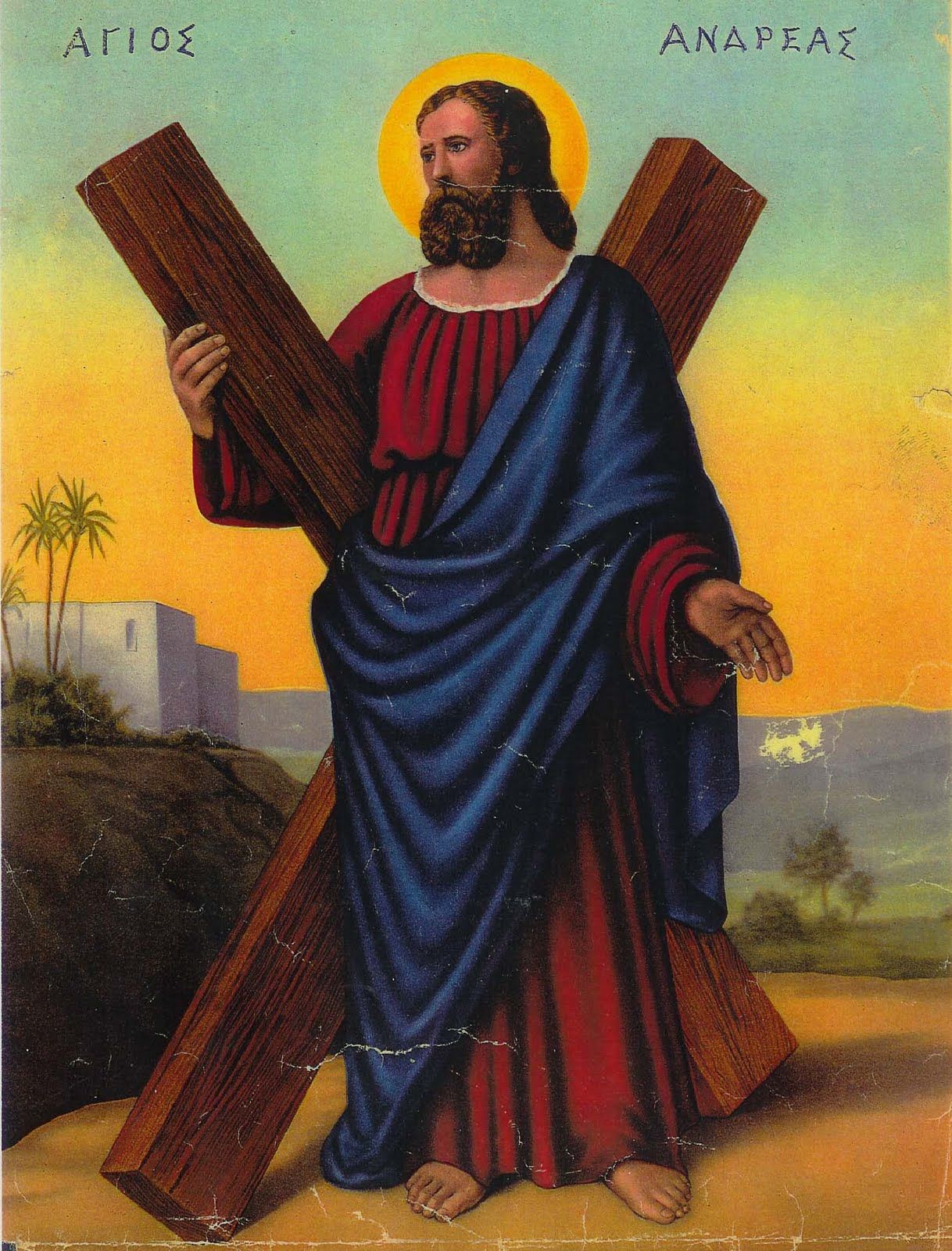
Remembered on 30 November each year, Andrew the Apostle is Patron Saint of the Church of Constantinople. The brother of Saint Peter, he was the first apostle to be called by Jesus and to have been martyred on a diagonal cross. He is patron of fisherman.
Personal Life
“We have found the Messiah”, expresses the great joy of the apostle Andrew. Those are the words we find in John’s Gospel when Andrew rushes to meet his brother Simon Peter to tell him what he has discovered and to share his joy at being the first one called by Jesus. A fisherman from Bethsaida of Galilee and a disciple of John the Baptist, Andrew recognizes the “Lamb of God” in the son of Joseph the carpenter. The disciple recalled the time of this encounter at the Jordan river that would mark his life forever, “it was about four in the afternoon”.
“Rabbi, where are you staying?” Jesus responded immediately to this question of Andrew and the other disciple, saying, “Come, and you will see”. That clear invitation foreshadowed the following, more explicit call Jesus made on the shore of the Sea of Galilee to Simon, “Come after me, and I will make you fishers of men”. The two disciples were still taken aback, but did not have any hesitation following Jesus, as the evangelist Matthew writes, “At once they left their nets and followed him”.
From that first exchange with each other, a journey of faith began in following Jesus in his daily ministry. Andrew is one of the twelve apostles, whom the Son of God chose as one of his closest friends. He must have been amazed when he witnessed the multiplication of the loaves of bread and fish. Before the miracle, when he turned his gaze on the hungry crowds and saw only five loaves of bread and two fish, he asked “what good are these for so many?”
The preaching of the Good News continued tirelessly throughout Achaea and in Patras by around the year 60 AD. He was martyred there and crucified on a diagonal cross which he requested as a way to evoke the Greek initial used for the name of Christ. According to the Golden Legend, before giving his last breath, he was to have pronounced these words: “Cross, sanctified by the body of Christ. Good Cross, long desired always, I loved you and wished to embrace you. Welcome me and bring me to my master". [1]
Missions
The faith of Andrew grew day by day, when at one point Jesus invited him, Peter, James, and John, to go up to the Mount of Olives where he answered their questions about the signs of the last days. Andrew is known to have brought a group of Greeks to Jesus who wanted to meet him, but the Gospels do not reveal other specific news about him. The Acts of the Apostles notes that he went to Jerusalem together with his other companions after the Ascension. The rest of the information on the life of the saint is found in non-canonical and apocryphal texts. “You will be a column of light in my kingdom”, Jesus is quoted as saying to Andrew, according to an ancient Coptic text. Christian writers of the first centuries say the apostle Andrew evangelized Asia Minor, the regions along the Black Sea, until he reached the Volga. Today he is honored as a patron saint in Romania, Ukraine and Russia. [1]
Legacy
The legacy of Saint Andrew, the "First-Called" apostle, is defined by his unique role as a bridge-builder. Unlike his brother, Saint Peter, who became the central leader and "rock" of the Church, Andrew’s legacy is one of personal introduction. In the Gospels, Andrew is almost always seen bringing someone to Jesus: first his brother Peter, then the boy with the five loaves and two fish, and later a group of Greeks seeking the Truth. This "apostleship of the personal touch" remains a model for how one individual can change history simply by making a timely introduction.
Historically, Andrew left an indelible mark on the geography of Eastern Christianity. He is traditionally considered the founder and first bishop of the church in Byzantium (later Constantinople, now Istanbul). Because of this, he is the patron saint of the Ecumenical Patriarchate of Constantinople, making him the spiritual father of the Eastern Orthodox Church in the same way Peter is seen by the Roman Catholic Church. This dual legacy of the two brothers—Andrew in the East and Peter in the West—serves today as a powerful symbol of the ongoing quest for Christian unity and ecumenical dialogue.
In terms of iconography and martyrdom, Andrew’s most recognizable legacy is the Saltire, or the X-shaped cross. Tradition holds that when he was sentenced to death in Patras, Greece, he deemed himself unworthy to be crucified on a cross identical to Christ’s and requested an X-shape instead. This "Saint Andrew’s Cross" transcended religious art to become a major heraldic symbol, appearing on the national flags of Scotland and Jamaica, as well as the naval ensign of Russia. It has become a global icon of humility and steadfastness under pressure.
Finally, Andrew remains the Patron Saint of Fishermen, a nod to his original profession on the Sea of Galilee. His legacy is one of immediate action; the biblical account emphasizes that he "at once" left his nets to follow a higher calling. As you navigate your final year of high school and your various programming projects in 2026, Andrew’s story of rapid transition and his ability to connect disparate groups—like the Greeks and the Jews—offers a compelling metaphor for leadership and networking in the modern world.