| Saint Benedict | |
|---|---|
 |
|
| Birth | 480 AD. Nursia, Umbria, Italy |
| Death | March 21, 547. Monte Cassino, Italy |
| Canonization | 1220 |
| Feast Day | |
Born in the central Italian mountain town of Norcia (Nursia) around AD 480, St. Benedict became one of the most important catalysts for the creation of a new European culture after the fall of the Roman Empire in the West (traditionally dated to AD 476). The system of monastic life he developed and nourished spread centers of prayer and hospitality throughout the continent. Benedictine monasteries were not only spiritual and cultural centers, but also a source of sustenance and relief for pilgrims and the poor.
Personal Life
St Benedict was born around the year 480. As St Gregory said, he came "ex provincia Nursiae" - from the province of Norcia. His well-to-do parents sent him to study in Rome. However, he did not stay long in the Eternal City. As a fully plausible explanation, Gregory mentions that the young Benedict was put off by the dissolute lifestyle of many of his fellow students and did not wish to make the same mistakes. He wanted only to please God: "soli Deo placere desiderans" (II Dialogues, Prol. 1).
Thus, even before he finished his studies, Benedict left Rome and withdrew to the solitude of the mountains east of Rome. After a short stay in the village of Enfide (today, Affile), where for a time he lived with a "religious community" of monks, he became a hermit in the neighbouring locality of Subiaco. He lived there completely alone for three years in a cave which has been the heart of a Benedictine Monastery called the "Sacro Speco" (Holy Grotto) since the early Middle Ages. The period in Subiaco, a time of solitude with God, was a time of maturation for Benedict. It was here that he bore and overcame the three fundamental temptations of every human being: the temptation of self-affirmation and the desire to put oneself at the centre, the temptation of sensuality and, lastly, the temptation of anger and revenge.
In fact, Benedict was convinced that only after overcoming these temptations would he be able to say a useful word to others about their own situations of neediness. Thus, having tranquilized his soul, he could be in full control of the drive of his ego and thus create peace around him. Only then did he decide to found his first monasteries in the Valley of the Anio, near Subiaco.
In the year 529, Benedict left Subiaco and settled in Monte Cassino. Some have explained this move as an escape from the intrigues of an envious local cleric. However, this attempt at an explanation hardly proved convincing since the latter's sudden death did not induce Benedict to return (II Dialogues, 8). In fact, this decision was called for because he had entered a new phase of inner maturity and monastic experience.
According to Gregory the Great, Benedict's exodus from the remote Valley of the Anio to Monte Cassio - a plateau dominating the vast surrounding plain which can be seen from afar - has a symbolic character: a hidden monastic life has its own raison d'être but a monastery also has its public purpose in the life of the Church and of society, and it must give visibility to the faith as a force of life. Indeed, when Benedict's earthly life ended on 21 March 547, he bequeathed with his Rule and the Benedictine family he founded a heritage that bore fruit in the passing centuries and is still bearing fruit throughout the world. [1]
The Rule
Benedict composed his Rule around AD 530. It is essentially a manual, a code for monastic life. Written in a familiar style, Benedict throughout the prologue and 73 chapters of the Rule exhorts his monks to reach out with “the ear of the heart” to “never despair of the mercy of God”: “Listen carefully, my child, to your master's precepts, and incline the ear of your heart (Prov. 4:20). Receive willingly and carry out effectively your loving father’s advice, that by the labor of obedience you may return to Him from whom you had departed by the sloth of disobedience.” [2]
In his Rule he describes monastic life as "a school for the service of the Lord" (Prol. 45) and advises his monks, "let nothing be preferred to the Work of God" [that is, the Divine Office or the Liturgy of the Hours] (43, 3). However, Benedict states that in the first place prayer is an act of listening (Prol. 9-11), which must then be expressed in action. "The Lord is waiting every day for us to respond to his holy admonitions by our deeds" (Prol. 35). Thus, the monk's life becomes a fruitful symbiosis between action and contemplation, "so that God may be glorified in all things" (57, 9).
Benedict describes the Rule he wrote as "minimal, just an initial outline" (cf. 73, 8); in fact, however, he offers useful guidelines not only for monks but for all who seek guidance on their journey toward God. For its moderation, humanity and sober discernment between the essential and the secondary in spiritual life, his Rule has retained its illuminating power even to today. [1]
Canonization and Beatification
St. Benedict was canonized in 1220 in Rome by Pope Honorius III. Originally his feast day was March 21, which is said to be the day he died. However, since this date falls within the Lenten season, his feast day was moved to July 11. His sister, St. Scholastica, is celebrated on February 10. [3]
Miracles and Testimonies
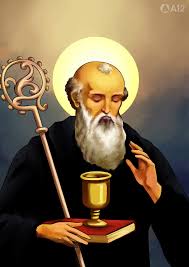
- Glass Full of Poison - The abbot of a nearby monastery died, and the monks there asked Saint Benedict if he would become their new abbot. He declined at first, but they insisted, so he agreed. Benedict was stricter than the previous abbot, and soon the monks came to hate Benedict. They decided to kill him and put some poison in his glass of wine. But when he made the Sign of the Cross to bless the wine, the wine glass suddenly broke as if a rock had been thrown at it.
- The Saving of St. Placid - St. Benedict's miracle of St. Placid describes how the young monk Placidus fell into a lake, and St. Benedict, knowing this in spirit, sent St. Maurus to rescue him; Maurus ran on the water's surface to pull Placid out, attributing the miracle to Benedict's prayer, while Benedict credited Maurus's obedience, showcasing mutual faith and obedience in the Benedictine tradition.
- Moving a Stone - Some monks were busy building new cells at their abbey and came across a huge stone that blocked the path to their building. Even working all together, they were unable to move the stone. So what did they do? Call Saint Benedict, of course! He said a prayer for them that the stone would move, and – voilà! – The monks were able to easily move the stone.
Legacy
Gregory presented St Benedict as a "luminous star" in order to point the way out of the "black night of history" (cf. John Paul II, 18 May 1979). In fact, the Saint's work and particularly his Rule were to prove heralds of an authentic spiritual leaven which, in the course of the centuries, far beyond the boundaries of his country and time, changed the face of Europe following the fall of the political unity created by the Roman Empire, inspiring a new spiritual and cultural unity, that of the Christian faith shared by the peoples of the Continent. This is how the reality we call "Europe" came into being.
Today, in seeking true progress, let us also listen to the Rule of St Benedict as a guiding light on our journey. The great monk is still a true master at whose school we can learn to become proficient in true humanism. [1]
Prayer
Prayer to St. Benedict against evil:
"May the Holy Cross be my light! May the dragon never be my guide! Begone, Satan! Do not suggest to me thy vanities. Evil are the things thou profferest. Drink the poison thyself!"