| St. Jerome | |
|---|---|
 |
|
| Birth | 347 AD. Stridon, Dalmatia |
| Death | Sep 30, 420. Bethlehem, Israel |
| Feast Day | |
| Patron | Librarians, Translators, Scholars, Archivists |
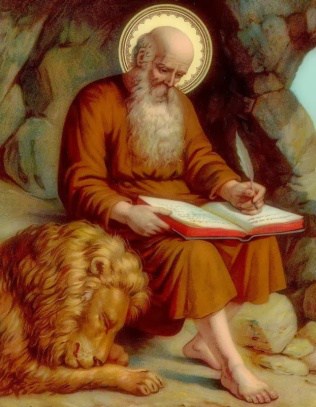
St. Jerome was a Roman Christian priest, theologian, and historian best known for translating the Bible into Latin, known as the Vulgate
Personal Life
In his Apostolic Letter Scripturae Sacrae affectus, on 30 September 2020 on the 16th centenary of the death of Saint Jerome, Pope Francis wrote: “The distinctive feature of Saint Jerome’s spirituality was undoubtedly his passionate love for the word of God entrusted to the Church in sacred Scripture. All the Doctors of the Church – particularly those of the early Christian era – drew the content of their teaching explicitly from the Bible. Yet Jerome did so in a more systematic and distinctive way”.
Born around 345 in Stridon, on the border between Dalmatia and Pannonia, today’s Croatia or Slovenia, he received a solid education in a Christian family. He moved to Rome and was baptised at the age of 19 by Pope Liberius. He studied rhetoric between 358 and 364 and was passionate about Latin literature. Once he had completed his studies, he went on a long journey to Gaul and stopped in the imperial city of Treveris, now Germany. In that city he came into contact with the eastern monastic experience of Saint Athanasius. He then moved to Aquileia with some friends and lived a period of shared community life.
Whereas the Books of the New Testament had been written in Greek, for the Old Testament there was only one complete version known as the Septuagint, (the version of the Seventy) which had been translated into Greek by the Hebrew community of Alexandria around the second century B.C.. There was no complete version in Latin, only some partial and incomplete translations. Saint Jerome and those who continued his work were responsible for the revision and a new translation of the entire Scriptures. Saint Jerome died in Bethlehem on 30 September 420. [1]
Missions
Around 374, he passed through Antioch and retreated into the Desert of Chalcis to lead an ascetic life and study the biblical languages, Greek and Aramaic. In the desert, he experienced God, his love and his mercy.
He was ordained a priest in Antioch by Bishop Paolino and then went to Constantinople around 379 where he met Gregory of Nazianzus. He continued his studies and dedicated himself to translating the homilies of Origen and Eusebius’ Chronicle into Latin and Greek.
In 382, he returned to Rome, at the service of Pope Damasus, becoming his close collaborator. He founded a coenobium on the Aventine Hill, where aristocratic Roman women practised ascesis and studied the Scriptures in depth.
During that time, he revised his earlier translations of the Gospels into Latin, and continued his work of translating the homilies and Scriptural comments of Origen. When Pope Damasus died, he had to leave Rome, and along with some friends and some women who wanted to continue their spiritual experience and their Bible studies, he moved to Egypt. In 386, he moved to Bethlehem where he resumed his philological studies. The importance he gave to holy sites is seen not only in his choice to live in Palestine from 386 until his death, but also in his service to the pilgrimages of the faithful who visited the Holy Land. At the grotto of the Nativity in Bethlehem, he founded two twin monasteries, one for men and one for women, with lodgings to welcome pilgrims, demonstrating his zeal in welcoming those who wanted to visit the sites of the history of salvation. [1]
Miracles and Testimonies
- The Lion and the Thorn - According to tradition, a lion entered Jerome's monastery in Bethlehem with a thorn in its paw. While other monks fled, Jerome cared for the animal, removing the thorn and domesticating it.
- Vision of Christ's Rebuke - While in the desert, Jerome had a vision in which he was brought before the judgment seat of Christ and accused of being a "Ciceronian" (a follower of Cicero) rather than a Christian, leading him to renounce pagan literature.
Legacy
Jerome is remembered in history for having revised and translated the Gospels and the Psalms, already in Rome, with the encouragement of Pope Damasus, and for having continued with the translation of the Old Testament in Latin, starting from the original version in Hebrew, during his stay in Bethlehem. It is known as the Vulgata. Up until that time, Christians in the Roman Empire could only read the Bible in its entirety in Greek. [1]