| Saint John the Baptist | |
|---|---|
 |
|
| Birth | 6 months BC. Ein Kerem, Judea |
| Death | 1st century AD. Fortress of Machaerus, Jordan |
| Feast Day | |
| Patron | Baptism, Conversion, Monastic Life, Hermits, Tailors, Printers, Booksellers |
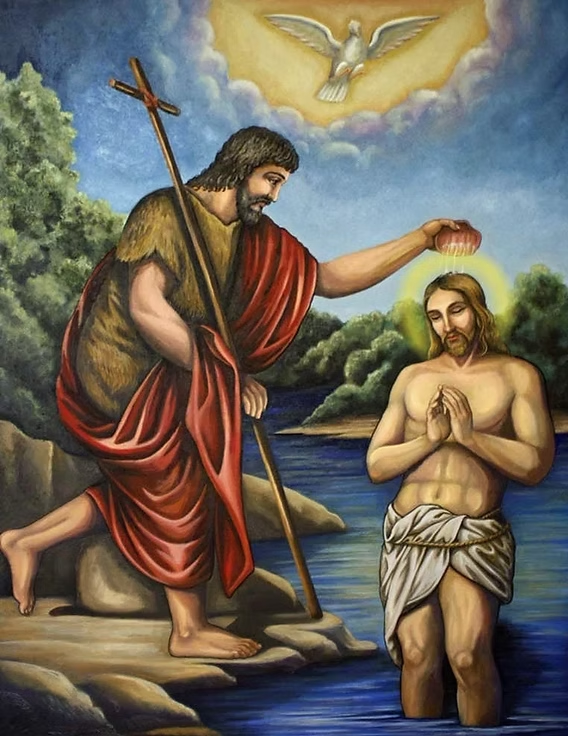
Saint John the Baptist was a Jewish prophet, cousin and forerunner of Jesus Christ, known for baptizing Jesus in the Jordan River and preaching repentance for the forgiveness of sins, ultimately being beheaded by King Herod for his condemnation of the king's marriage to Herodias. He lived an ascetic life in the wilderness, wearing camel's hair and eating locusts, and directed his followers to Jesus, whom he called the "Lamb of God".
Personal Life
When the time arrived for Elizabeth to have her child she gave birth to a son. Her neighbors and relatives heard that the Lord had shown his great mercy toward her, and they rejoiced with her. When they came on the eighth day to circumcise the child, they were going to call him Zechariah after his father, but his mother said in reply, “No. He will be called John.” But they answered her, “There is no one among your relatives who has this name.” So they made signs, asking his father what he wished him to be called. He asked for a tablet and wrote, “John is his name,” and all were amazed. Immediately his mouth was opened, his tongue freed, and he spoke blessing God. Then fear came upon all their neighbors, and all these matters were discussed throughout the hill country of Judea. All who heard these things took them to heart, saying, “What, then, will this child be?” For surely the hand of the Lord was with him. (Lk. 1:57-64).
The people were amazed because of this child, as well as by this sterile couple, who were advanced in age, who had a son. Their wonder was illuminated by faith. This is why they “took to heart” what they had heard and what they saw, and they praised God. Their amazement was accompanied by the awareness that they did not understand everything: “What, then, will this child be?” This is a legitimate question since if they had understood everything, God would not have been a part of it!
“The birth of John the Baptist is surrounded by a joyous sense of wonder, surprise and gratitude…. The faithful people sense that something great has occurred, even though it is humble and hidden…. The people are able to live the faith with joy, with a sense of wonder, of surprise and of gratitude. Do I feel a sense of wonder when I see the Lord’s works, when I hear about evangelization or the life of a saint?... Am I able to feel the Spirit’s consolation or am I closed?” (Pope Francis, Angelus, 24 June 2018) [1]
John the Baptist saw Jesus coming toward him and said, "Behold, the Lamb of God, who takes away the sin of the world. He is the one of whom I said, 'A man is coming after me who ranks ahead of me because he existed before me.' I did not know him, but the reason why I came baptizing with water was that he might be made known to Israel." John testified further, saying, "I saw the Spirit come down like a dove from the sky and remain upon him. I did not know him, but the one who sent me to baptize with water told me, 'On whomever you see the Spirit come down and remain, he is the one who will baptize with the Holy Spirit.' Now I have seen and testified that he is the Son of God." (John 1:29-34)
Having accomplished his mission, John knows how to step aside, he withdraws from the scene to make way for Jesus. He has seen the Spirit descend upon him (cf. vv. 33-34), he has indicated him as the Lamb of God who takes away the sin of the world, and now he in turn humbly listens. He goes from prophet to disciple. He preached to the people, gathered disciples and trained them for a long time. Yet he does not bind anyone to himself. And this is difficult, but it is the sign of the true educator: not binding people to oneself. John does this: he sets his disciples in Jesus’ footsteps. He is not interested in having a following for himself, in gaining prestige and success, but rather bears witness and then takes a step back, so that many would have the joy of meeting Jesus. We can say: he opens the door, then he leaves. [2]
A woman played the primary role in his martyrdom. Herodias, the wife of Herod Antipas, was the former wife of his half-brother. John was arrested because he had denounced her illegal marriage. During the celebration of Herod’s birthday, Herodias’s daughter, Salome, performed a dance in honor of the king who remained enchanted and told her she could ask him for anything she wanted, even to half of his kingdom. After consulting her mother, Salome asked for the head of John the Baptist. Herod did not want to do it, but could not refuse: he had, after all, made a promise. [3]
Devotion
The Church celebrates the Solemnity of the Nativity of Saint John the Baptist, and on 29 August, we will celebrate the memorial of his martyrdom. There is no other saint for whom the Church celebrates both of these moments. Generally, it celebrates only their “birth into heaven”, with the exception, of course, of Jesus, the Son of God (25 December – his birth; and Good Friday – his death) and the Virgin Mary (8 September – her birth; and 15 August – her Assumption into heaven).
Jesus himself said, “Amen, I say to you, among those both of women there has been none greater than John the Baptist” (Mt. 11:11). He was the last of the great prophets of Israel, the first to testify to Jesus, who initiated a baptism for the forgiveness of sins and, in this context, baptized Jesus; he was a martyr who died defending the Judaic law.
As early as the 4th century, we find a liturgical commemoration for Saint John the Baptist celebrated on a variety of dates. The date of 24 June was established based on Lk 1:36a where speaking of Elizabeth it says, “this is the sixth month for her who was called barren”, therefore, six months before Christmas. Since the 6th century, this Feast also had a vigil. [1]
Legacy
The Baptist dies a martyr. Not a martyr of the faith, because he was not asked to renounce it. He is a martyr of truth. He was, in fact, a “righteous and holy man” (Mk 6:20) who was put to death because he spoke freely and was faithful to his calling.
He is a martyr who allowed himself to diminish so as to leave his place to the Messiah. “Those who are great end up like this!”. But John knew he had to be annihilated: “He must increase, I, instead, decrease”. And, added Pope Francis, “he decreased to the point of death”. John had pointed Jesus out to His first disciples, indicating that He was the Light of the world. He, instead, gave his life little by little, to the point of being extinguished in the darkness of a prison cell.
“Life has value only when we give it; when it is given in love, in truth; when we give it to others, in daily life, in our families. It should always be given. If someone grasps his or her life in order to keep it, like the king by his corruption, or the woman with her hatred, or the child, the young girl with her vanity that was that of an adolescent, naive, life dies, life ends up withered, it is useless” (Homily of Pope Francis, Santa Marta, 8 February 2019). [3]