| Saint John the Evangelist | |
|---|---|
 |
|
| Feast Day | |
| Patron | Love, Loyalty, Friendships, Authors, Booksellers, Editors, Publishers, Scholars, Theologians, Against Burn/Poison Victims. |
The “beloved disciple” was an impetuous fisherman who became a disciple of Jesus, the only one of the apostles not to be martyred. Tradition holds him to be the author not only of the fourth Gospel, but of the Johannine letters and the Book of Revelation.
Personal Life
When two young Jewish fishermen sat by the Sea of Galilee, mending their nets with their father, a man walked by and said, “Follow me.” Their response reveals the startled glimmer of recognition they must have had in that moment: “Immediately they left their boat and their father and followed him” (Mt 4:22). In this rabbi who was calling them, James and John, the sons of Zebedee – tradition holds that John was the younger of the two – caught a glimpse of something for which, as faithful Israelites, they had been waiting all their lives.
John must have often gone back in his mind to that moment when he left his nets to follow the Messiah. Yet during his three years at Jesus’ side, watching him pray, teach, raise a dead child, and calm the wind and the waves, the fisherman could not have imagined that one day he would watch his Master die on a cross. He could not have known that, as he saw his friend’s body placed in the tomb, the words he had learned as a Jewish child would take on an infinitely greater meaning: “Your face, O Lord, I seek; hide not your face from me” (Ps 27:8-9).
The apostle John must have been an impetuous young man. We glimpse what Jesus meant when he called Zebedee’s sons, “sons of thunder,” when they ask if they might call down fire from heaven on those who did not welcome their Lord (Lk 9:51-55). The brothers also ask – oblivious as to what they are asking – to sit at the Lord’s right hand in his “glory,” a glory they likely conceived in earthly terms (Mt 20:20-28). Both times, they are reprimanded. But in all this, John, whom tradition identifies as the “beloved disciple” in John’s gospel, was learning love.
Love was near enough to touch in those three years as a disciple, and above all in those three days that began with his Master washing the disciples’ feet like a slave. John is the only apostle the gospels record as present when Jesus died, watching with Jesus’ mother and other women as the Son of God cried out to his Father. John heard another word there, to Mary, about him: “Behold your son.” And to him, “Behold your mother,” entrusting her to his care (Jn 19:26-27). Finally, he watched as a soldier thrust a lance into Jesus’ side and the blood of the Covenant flowed over the earth. “An eyewitness has testified,” John’s gospel insists at this point, “and his testimony is true” (Jn 19:35).
The First Letter of John begins, “What was from the beginning … what we have seen with our eyes … and touched with our hands….” (1 Jn 1:1). The disciple who has seen and touched the Word made flesh cannot forget it. That experience taught him: “God is love, and whoever remains in love remains in God, and God in him” (1 Jn 4:16).
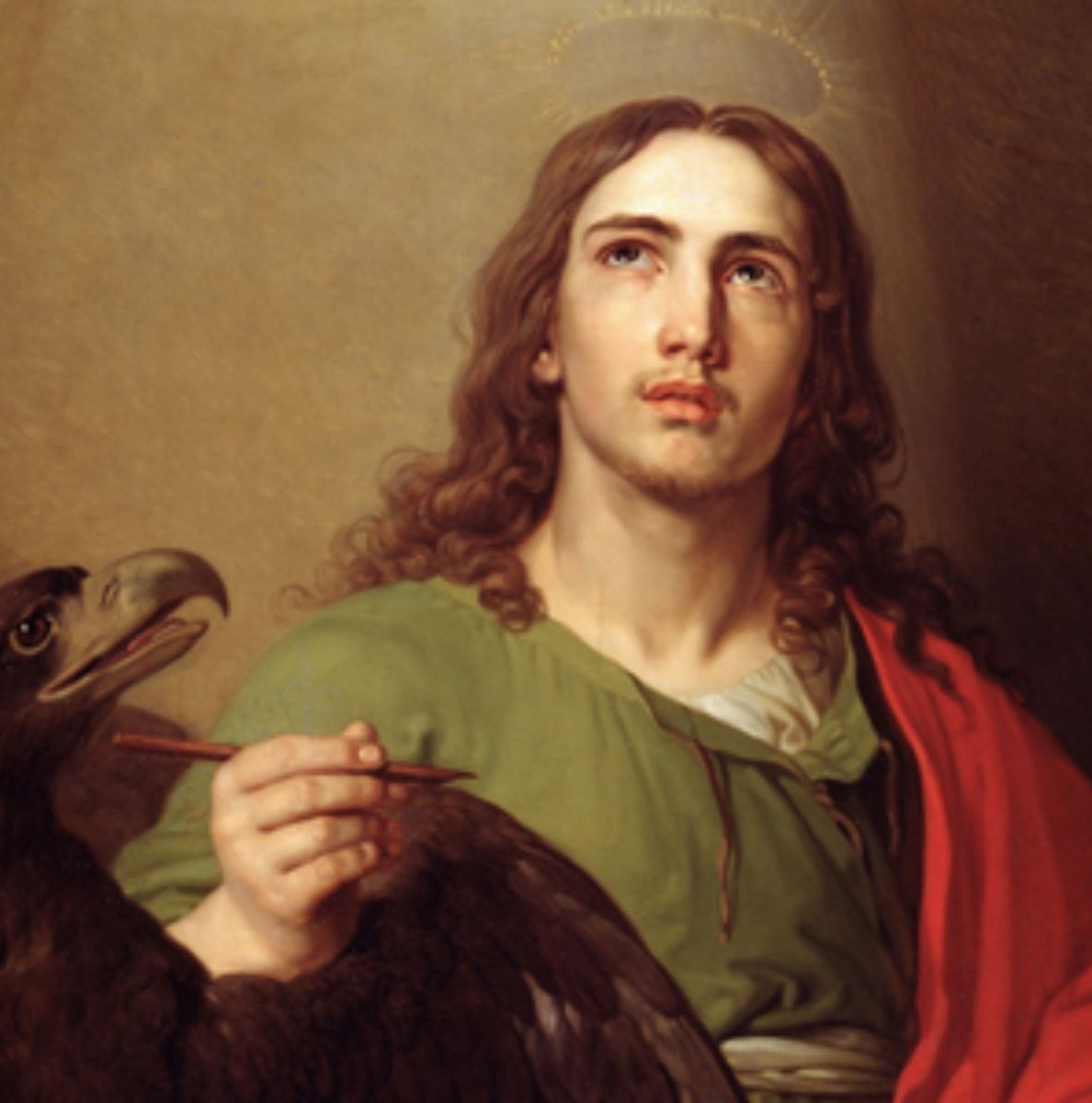
Tradition holds that John, the only one of the apostles not to be martyred, lived at Ephesus with the Mother of God after the apostles had been scattered. During the reign of the Emperor Domitian, he was exiled as an old man to the island of Patmos. There, the one to whom love had given clear sight to see as far as “the beginning” – iconography presents St. John with an eagle to symbolize this – is given to see also the end.
“I, John, your brother” the Book of Revelation begins (Rev 1:9). The visions in that book, given to strengthen the Church during a time of persecution, are also the full revelation of Christ’s Lordship. Yet it was a familiar voice that John heard in the cry, “I am the Alpha and the Omega, the beginning and the End!” (Rev 21:6). He had seen, heard, and touched the Lord of time and history, who bore the face of his Master and friend. [1]
Legacy
The legacy of Saint John the Evangelist is anchored in his unique role as the "Beloved Disciple," credited with writing the Fourth Gospel, three Epistles, and the Book of Revelation. Unlike the other apostles, John’s writings move beyond a simple historical record to provide a profound theological framework for Christianity. By introducing the concept of Jesus as the Logos (the Word), he bridged the gap between Greek philosophy and Jewish tradition, establishing the foundational belief in Christ’s divinity that has shaped Western thought for two millennia.
Beyond his intellect, John left a lasting legacy as the Apostle of Love. His writings famously distilled the complex laws of faith into a singular, recurring command: "Little children, love one another." This focus on divine and brotherly love—symbolized by his intimate position leaning against Jesus at the Last Supper—shifted the early Church’s emphasis toward a more mystical and personal relationship with the divine. This "Johannine" tradition of love remains the core ethical heartbeat of many modern Christian denominations.
John’s influence also extends into the visionary and the mysterious through his exile on the Island of Patmos. As the purported author of the Book of Revelation, he provided the vivid, apocalyptic imagery—such as the Four Horsemen and the New Jerusalem—that has dominated Western art, literature, and cinema. This visionary legacy created the primary vocabulary for how the world imagines the "end of days," influencing everything from medieval cathedrals to modern-day pop culture.
Finally, as the only apostle tradition says died of old age rather than martyrdom, John served as a vital living bridge. He transitioned the Church from the generation of eyewitnesses to the era of organized theology, personally mentoring early leaders like Polycarp. This longevity ensured that the original apostolic message remained intact, providing a sense of stability and continuity that allowed the early movement to survive and eventually thrive across the Roman Empire.