| Saint Joseph | |
|---|---|
 |
|
| Birth | 1st century BC. Nazareth, Galilee |
| Death | 1st century AD. |
| Canonization | Dec. 8, 1870 |
| Feast Day | |
| Patron | Universal Church, Fathers, Families, Workers, Carpenters, Immigrants, Travelers, Expectant Mothers |
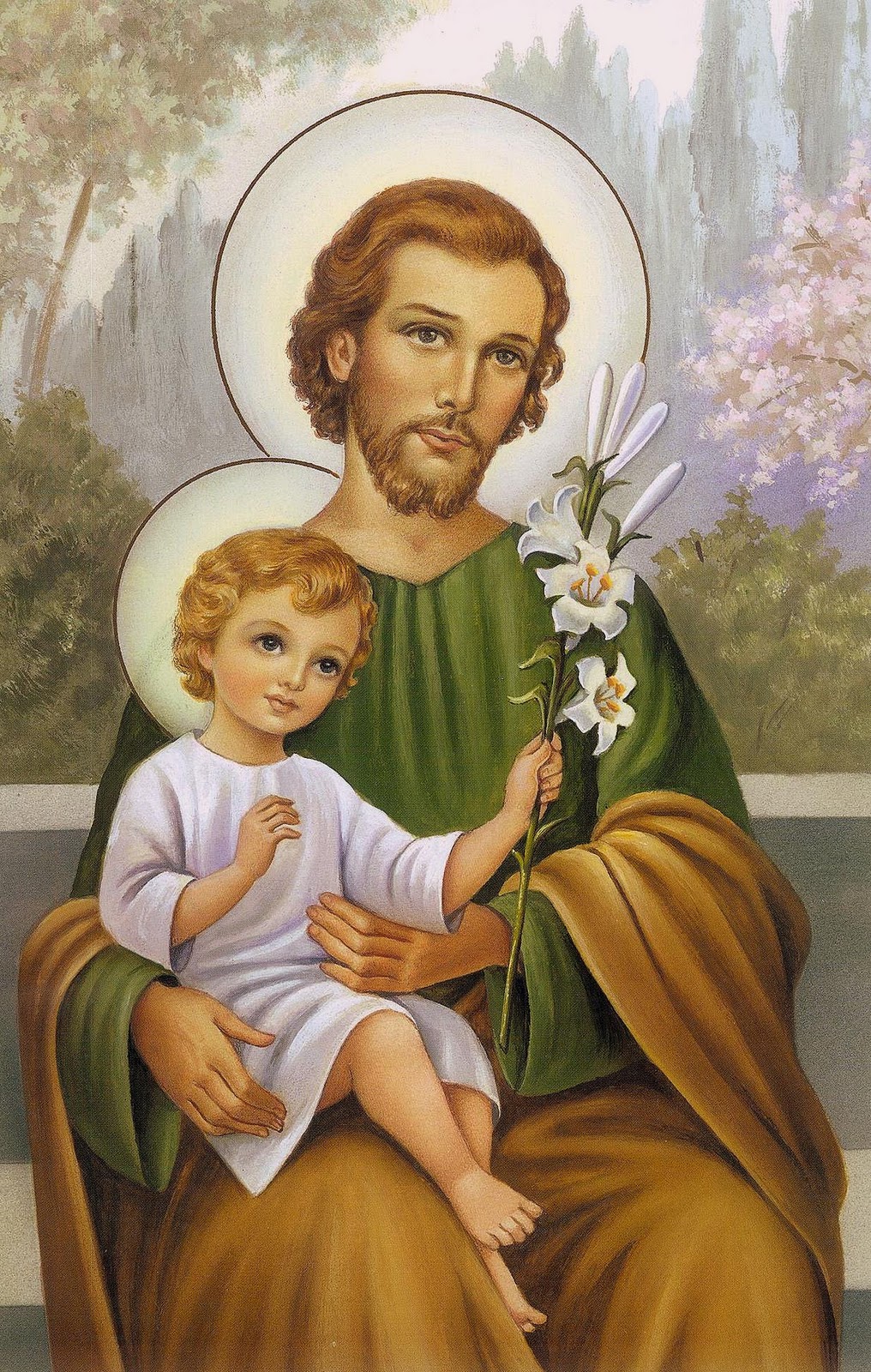
Jesus certainly loved St Joseph as a son loves his father. Which is why we celebrate St Joseph as Protector of Families and Patron Saint of Workers. That is also why St Joseph has two feast days: March 19th, as the Spouse of Mary, and May 1st, under the title of Joseph the Worker.
Personal Life
Jacob was the father of Joseph, the husband of Mary. Of her was born Jesus who is called the Christ. Now this is how the birth of Jesus Christ came about. When his mother Mary was betrothed to Joseph, but before they lived together, she was found with child through the Holy Spirit. Joseph her husband, since he was a righteous man, yet unwilling to expose her to shame, decided to divorce her quietly. Such was his intention when, behold, the angel of the Lord appeared to him in a dream and said, “Joseph, son of David, do not be afraid to take Mary your wife into your home. For it is through the Holy Spirit that this child has been conceived in her. She will bear a son and you are to name him Jesus, because he will save his people from their sins.” When Joseph awoke, he did as the angel of the Lord had commanded him and took his wife into his home. (Mt. 1:16, 18-21, 24) [1]
Confronted with Mary’s pregnancy, he faces the weight of the Law, which demanded a definitive, public resolution. Yet, Joseph does not let legalism override the truth of the person before him. He sees what is before him, but he refuses to absolutize the appearance of sin. He knows Mary’s holiness too well to rush to condemnation. Saint Jerome captures this delicate balance with remarkable insight: Joseph, “confident in her purity and wondering at what had happened, covered in silence that mystery which he could not explain.” This silence was a hidden martyrdom; to protect the mystery, Joseph was willing to forgo his own reputation for 'legal' righteousness, appearing to the world as either morally compromised or tragically confused. His righteousness consists in willing to be judged while refusing to judge what he does not fully know. [2]
Joseph certainly loved Jesus with all the tenderness that a father feels for his own son. Moreover, he protected and educated this mysterious and wise child who was entrusted to his care. Educating Jesus must have been an immensely challenging task: imagine telling the Son of God what is right and what is not. Protecting Him must have been equally difficult. After searching for Him anxiously for three days (while Jesus remained behind in the Temple discussing with the Doctors of the Law), Joseph had to hear a twelve-year old boy tell him: "Did you not know that I must be busy with my Father’s affairs?”. Perhaps Joseph felt like every other Father who, sooner or later, has to accept the fact that his child really does not belong to him – but to God alone, who holds that child’s destiny in His hands.
Joseph does not appear in any of the four Gospels that recount the public life of Jesus, nor at His crucifixion on Calvary, nor at the Resurrection. It is fair to presume, therefore, that he died before Jesus began his preaching. According to tradition, Joseph died with Mary and Jesus by his side – which is why he is also invoked as the Protector of the Dying. It is the wish of every one of us to leave our earthly home in the company of Jesus and His Mother. [3]
The Just Man
In his Gospel, Matthew describes St Joseph as "just". Mary’s future husband, faced with the inexplicable pregnancy of his fiancé, does not consider his wounded pride or dignity. Instead, his first thought is to save her from popular animosity or, worse still, from the stoning to which she risks being condemned. He does not want to repudiate her publicly but intends divorcing her informally and in secret. It’s precisely at that moment of understandable anguish and suffering that the love of God comes, in the shape of an Angel, to encourage him. The Angel inspires Joseph to make the right choice, which is always to overcome fear. These are the words of the Angel: "Joseph, son of David, do not be afraid to take Mary home as your wife, because she has conceived what is in her by the Holy Spirit. She will give birth to a son and you must name Him Jesus". [3]
The Gospel of St Matthew describes Joseph as a “just man”, which in the language of the Bible means one who loves and respects the law as the expression of the will of God. Like Mary, Joseph too was visited by an angel, who appeared to him in a dream. And, again like Mary, her spouse, Joseph said “Yes”, when the angel revealed that the Child she bore was conceived of the Holy Spirit.
The special characteristic of Joseph is hiddenness, remaining in the background. No word of his is recorded in the Gospels. He is not mentioned after the finding of Christ in the Temple. Probably by the time Jesus began his public life, at the wedding in Cana, Joseph had already passed to the next life, although we don’t know exactly when or where he died. And the place of his burial remains a mystery. [4]
Miracles and Testimonies
- Loretto Chapel Staircase (New Mexico) - A mysterious, spiraling staircase built without visible support after nuns prayed to St. Joseph for help.
- Cotignac (France) - St. Joseph appeared to a thirsty shepherd, telling him to lift a rock where he found water and a spring.
- St. Joseph's Mantle - A legend describes his mantle healing ailments and bringing harmony when offered as security for wood.
Devotion
In the West, the oldest reference to the cult of Saint Joseph (Ioseph sponsus Mariae) connected with 19 March appears around the year 800 in the north of France. Thereafter, reference to Joseph, the spouse of Mary, becomes more and more frequent from the 9th to the 14th centuries. In the 12th century, the crusaders built a church in his honor at Nazareth. But it was in the 15th century that the cult of Saint Joseph spread due to the influence of Saint Bernadine of Siena, and especially of Jean Gerson (+ 1420), Chancellor of Notre Dame in Paris, who promoted the cause that a feast to Saint Joseph be officially established. There were already some celebrations in Milan in Augustinian circles, and in many places in Germany. It was in 1480, with Pope Sixtus IV’s approval that the feast began to be celebrated on 19 March. It then became obligatory with Pope Gregory XV in 1621. In 1870, Pope Pius IX declared Saint Joseph the Patron of the Universal Church, and Pope Saint John XXIII inserted his name into the Roman Canon of Holy Mass in 1962. More recently, Pope Francis approved seven new invocations in the Litany to Saint Joseph: Guardian of the Redeemer, Servant of Christ, Minister of Salvation, Support in difficulties, Patron of exiles, Patron of the afflicted, and Patron of the poor. [1]
The feast of Saint Joseph the Worker: This feast was officially instituted by Pope Pius XII on 1 May 1955, in order to ensure that workers not lose this Christian understanding of work; but earlier Popes had already prepared the ground. Blessed Pius IX in a certain way had recognized the importance of Saint Joseph as a labourer, when he proclaimed him Patron of the Universal Church. The principle of work as a means to eternal salvation would be taken up again by St John Paul II in his encyclical Laborem exercens, where he refers to “the Gospel of Work”. And Cardinal Angelo Roncalli – who became Pope St John XXIII – when he was elected to the Throne of Peter had thought of taking the name Joseph, so devoted was he to the saint who was the foster-father of Jesus. Many other saints, especially St Teresa of Avila, had a particular devotion to Saint Joseph. [4]
Legacy
Joseph the Just thus stands as a luminous figure for our time. He teaches us that righteousness is not loud, reactive, or self-assured. It is patient, truthful, and humble enough to wait. In a world fractured by false certainty and corrosive doubt, Joseph shows us that the path of truth—however incomplete it may seem—is the very place where Emmanuel still chooses to dwell. [2]
The life of St Joseph shows us the dignity of human work, which is the duty and the perfection of human beings, who in this way exercise dominion over creation, share in the work of the Creator, offer their service to the community, and participate in God’s plan of salvation. Joseph loved his work. He never complained of weariness, but as a man of faith elevated it to the exercise of virtue. He found contentment in his work, because he did not aspire to wealth and did not envy the rich; for Joseph, work was not a means to satisfy his own greed, but an instrument to support his family.
And, following God’s commandment, on the Sabbath St Joseph observed the weekly rest and took part in the celebrations. We should not wonder at this noble conception of the humble work of manual labour: already in the Old Testament, in fact, God was seen symbolically as a winegrower, a sower, a shepherd. [4]
Prayer
"Hail, Joseph, full of grace, The Lord is with you. Blessed are you among all men, And blessed is your foster Child, Jesus. Holy Joseph, guardian of the Son of God, Pray for us sinners, Now, and at the hour of our death. Amen."
Bibliography
- Vatican News - Solemnity of Saint Joseph, the Spouse of the Blessed Virgin Mary (19 March)
- Vatican News - Lord’s Day Reflection: The righteousness of Joseph (19 December 2025)
- Vatican News - St. Joseph, Spouse of the Blessed Virgin Mary, Patron of the Universal Church (19 March)
- Vatican News - St Joseph the Worker, Spouse of the Blessed Virgin Mary, Patron of Workers (01 May)