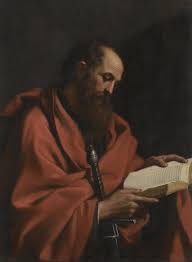
| Saint Paul | |
|---|---|
 |
|
| Birth | 1st century AD. Tarsus, Türkiye |
| Death | June 29, 67 AD. Rome, Roman Empire |
| Feast Day | |
| Patron | Missionaries, Evangelists, Writers, Journalists, Authors, Public Workers, Rope and Saddle Makers, Tent Makers |
The Apostle to the Gentiles, St. Paul was the greatest missionary in history. A Pharisee converted to Christ, his concern for expounding the faith to those, who heard him, would make him the first Christian theologian. His martyrdom is remembered on June 29, together with that of St. Peter.
Personal Life
A Jew of Tarsus, in modern-day Turkey, Saul, a Roman citizen, educated at the Jewish school in Jerusalem, had also a good Greek-Hellenistic formation: he knew Greek and Latin. The son of a curtain weaver, he also learned his father's craft. Like many Jews at that time, he had a second Greco-Latin name: Paul, chosen for simple assonance with his own name. Stubborn, courageous and bold, Saul was a skilled debater. His personality emerges in the Acts of the Apostles and his 13 Letters. He never met Jesus while Our Lord was on Earth, and was among the first to persecute Christians, whom he considered a dangerous sect to be overthrown. In the Scriptures he is mentioned for the first time in the narrative of the stoning of St. Stephen - the first Christian martyr - in Jerusalem. A proud advocate of Jewish tradition, Saul, “sought to destroy the Church: he went into the houses, took men and women, and put them in prison” (Acts 8: 3). The disciples feared him, and to escape the persecution, some fled to various cities, including Damascus.
After the stoning of Stephen, Saul was authorized by the high priest to execute the fugitives in Jerusalem. “And as he went on his journey, it came to pass that he drew nigh to Damascus; and suddenly a light from heaven shined round about him.And falling on the ground, he heard a voice saying to him: Saul, Saul, why persecutest thou me? Who said: Who art thou, Lord? And he: I am Jesus whom thou persecutest. It is hard for thee to kick against the goad. And he trembling and astonished, said: Lord, what wilt thou have me to do? (Acts 9: 3-6)” He was escorted to Damascus, where for three days, upset by the incident, he took neither food nor drink. On the third day, a certain Ananias presents himself, whom God, during a vision, had asked to seek Saul and to impose his hands on him in order to restore Saul’s sight, which had been taken from him in the incident on the road to Damascus. “He is the instrument I have chosen for myself, that you may bring my name before the nations, kings, and children of Israel; and I will show him how much he will suffer for my name,” it was revealed to Ananias. Saul is baptized Paul, he meets the small Christian community of the place, presents himself in the synagogue and testifies to what happened to him. This was the beginning of his mission. He stayed with the disciples who are in Damascus, began to preach with enthusiasm, and then went to Jerusalem.
There, he met Peter and the other Apostles, who, after an initial mistrust, welcomed him and spoke to him at length of Jesus. Paul listened to them, learned the teachings left by the Master, and grew in strength of faith. His preaching continued, but clashed with the hostility of many Jews and the perplexity of diverse Christians. He left Jerusalem and returned to Tarsus, where he resumed the craft of curtain weaving and continued to devote himself to evangelization. A few years later Paul, along with Barnabas, who was among the first converted Jews, came to Antioch and established close ties with the Christian community there.
Accused then by the Jews of having preached against the law and having introduced into the temple a converted pagan, he was arrested. Facing trial, Paul as a Roman citizen appealed to the Emperor and was transferred to Rome. After his imprisonment, he reached Caesarea, and made several stops in other cities. At Rome, where Peter also found himself, Paul came into contact with the Christian community. The charges against him were dismissed for lack of evidence, after which Paul continued his mission. He was arrested again under Nero, and condemned to death by the Roman court. He was beheaded on the Via Ostiense, while Peter was crucified on the Vatican Hill. Tradition reports that the martyrdom of Peter and Paul took place on the same day: June 29 of the year 67. The Basilica of St. Peter and the Basilica of St. Paul Outside the Walls stand over their respective tombs. [1]
Missions
After a brief stay in Jerusalem, Paul went out from Antioch to continue his mission in other destinations, both among Jews and especially among Pagans - the so-called “Gentiles”. He made three great Apostolic journeys. He landed first on Cyprus and then traveled to different cities of Galatia, where he founded many communities, then again reached Antioch and thence Jerusalem, to discuss with the Apostles whether converts from paganism had to abide by the precepts of Jewish tradition.
In the second journey Paul goes to the south of Galatia, then to Macedonia and Greece. He stopped at Corinth for over a year and then touches other cities, including Ephesus and Jerusalem, and went back to Antioch. From there, he set out for his third journey. Three years at Ephesus, then Macedonia, Corinth and other places, visiting communities that had previously welcomed him, before finally returning to Jerusalem. Because of the tensions that had developed between the communities he had founded and the Judeo-Christians over the observance of certain rules of Jewish law, he argued with James. [1]
Miracles and Testimonies
- Blinding Elymas the Sorcerer - In Cyprus, Paul caused the magician Elymas to become temporarily blind, leading to the conversion of the Roman proconsul Sergius Paulus.
- Viper Bite on Malta - After a shipwreck, a poisonous viper bit Paul, but he showed no ill effects, astonishing the islanders.
- Casting Out a Spirit of Divination - In Philippi, Paul cast a spirit of fortune-telling out of a slave girl, incurring the wrath of her owners.
Legacy
In his letter to the Romans, Pope Leo said, Paul acknowledges that he encountered Christ only because Christ reached out to him first—his encounter and his subsequent ministry were “the fruit of God’s prior love, which called him to a new life while he was still far from the Gospel.”
The Pope then turned to consider the role of faith in St. Paul’s account of his calling. When God appeared to Paul on the road to Damascus, Pope Leo said, “he did not take away his freedom,” but rather gave him “the opportunity to make a decision.” “Salvation does not come about by magic,” the Pope explained, “but by a mysterious interplay of grace and faith, of God’s prevenient love and of our trusting and free acceptance.”
The final aspect of Paul’s calling that Pope Leo considered was that of "justification," or the process of increasing in holiness. The Acts of the Apostles describes how, after his vision of Jesus, Paul ceased persecuting Christians, and began working alongside them. The Pope urged his listeners to “compete” in showing this kind of love, which led St. Paul to give himself so wholly to others that he was eventually martyred. [2]