| Saint Peter | |
|---|---|
 |
|
| Birth | 1st century BC. Bethsaida, Galilee, Israel |
| Death | June 29, 67 AD. Rome, Roman Empire |
| Feast Day | |
| Patron | Fishermen, Netmakers, Shipbuilders, Sailors, Locksmiths, Cobblers, Popes, Papacy, The Universal Church, Rome |
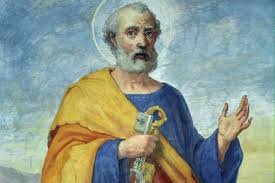
St. Peter (born Simon) was a Jewish fisherman, one of the Twelve Apostles, and a key leader in the early Christian Church, known as the first Pope by Catholic tradition; Jesus renamed him "Peter" (meaning "rock") and designated him the foundation of His Church.
Personal Life
His name was Simon; Jesus called him Peter. Simon was born in Bethsaida, and lived in Capernaum where was a fisherman on the Sea of Tiberias. The Teacher invited him, along with Andrew his brother, to follow Him; with James and John, He made Simon a witness to several important events: the raising of Jairus’ daughter, the Transfiguration, and the agony in the Garden of Gethsemane.
In his journey alongside the Messiah, Peter emerges as a simple, straightforward man, who is sometimes impulsive. He often speaks and acts on behalf of the apostles; he does not hesitate to ask Jesus for explanations and clarifications regarding His preaching or parables; and he questions Him on various matters.
And he is the first to respond when the Teacher addresses the Twelve. “Do you also want to leave?” Jesus asks after speaking in the synagogue of Capernaum, causing confusion even among many of His disciples, who from that moment decide to follow Him no longer. “Master, to whom shall we go?” Simon Peter replies. “You have the words of eternal life. We have come to believe and are convinced that you are the Holy One of God” (John 6:67–68).
At Caesarea Philippi, when Jesus asks His disciples, “Who do you say that I am?”, it is Peter who answers: “You are the Messiah, the Son of the living God” (Matthew 16:16). Jesus, in turn, replies: “And so I say to you, you are Peter, and upon this rock I will build my Church, and the gates of the netherworld shall not prevail against it. I will give you the keys to the kingdom of heaven. Whatever you bind on earth shall be bound in heaven; and whatever you loose on earth shall be loosed in heaven” (Matthew 16:18–19).
The apostles acknowledged the role given to Peter by Jesus, and he is the one who takes the initiative on several occasions. On Easter morning, informed by Mary Magdalene of the disappearance of the Master's body from the tomb, it is Peter who rushes there with another disciple. But the other disciple, even though he outruns him, lets Peter enter first — a sign of respect.
Peter strengthens the Christian community and is its leader. He is imprisoned during Nero’s persecution and is later crucified upside down at his own request; while Paul, condemned to death by the Roman tribunal, is beheaded. Tradition holds that their martyrdom occurred on the same day: June 29 of the year 67. Peter died in Nero’s Circus, and was buried on the Vatican Hill; Paul on the Via Ostiense. The Basilica of Saint Peter and the Basilica of Saint Paul Outside the Walls stand over their respective tombs. [1]
Missions
This is the mission entrusted to Peter: to govern the Church. The Gospels reveal that Jesus chose to entrust His Church to an uneducated fisherman, someone who at times failed to see God’s will and acted on instinct: Peter protests when Jesus speaks of His Passion; he tries to refuse the washing of his feet at the Last Supper, unable to accept such a humble gesture from the Master; he denies knowing Jesus three times after His arrest.
After Jesus’ Resurrection, the apostles gather in the Upper Room where their Master appears more than once. But then, each returns to his daily life, and Peter goes back to his boat and his nets. After a night of fishing the Master appears to him once more (John 21:3–7), asks him to tend His flock, and foretells the kind of death by which Peter would glorify God (John 21:15–19).
After Jesus’ Ascension, Peter becomes the reference point for the apostles and the first followers of Christ. He begins to speak in public, to preach, and to perform healings. He is arrested, summoned, and released multiple times by the Sanhedrin, the members of which are forced to acknowledge the authority with which he speaks and the growing enthusiasm of the people.
Peter also begins traveling from city to city to spread the Good News, though he often returns to Jerusalem. It is there that Paul presents himself one day to Peter and the other apostles, telling them of his conversion.
Peter and Paul then take different paths, both undertaking various journeys, though their lives frequently intersect in Jerusalem. Peter discusses and debates with Paul more than once, accepting his observations and reflections, and engages in discussions with him to help shape the direction of the nascent Church. Eventually, the two Apostles meet again in Rome. [1]
Miracles and Testimonies
- Shadow Healing (Acts 5:15-16) - People brought the sick into the streets hoping Peter's shadow would fall on them, and they were healed.
- Raising Tabitha (Acts 9:36-43) - In Joppa, Peter raised the devoted disciple Tabitha from the dead, causing many to believe.
- Healing the Lame Man (Acts 3:1-11) - At the Temple gate, Peter healed a man crippled from birth, telling him, "Silver or gold I do not have, but what I have I give you. In the name of Jesus Christ of Nazareth, walk"
Devotion
Perhaps we too, like Peter, find ourselves chained by our fears, our struggles and our fragility. Trapped by our feelings of guilt or by thinking that nothing will change. Yet, at every moment, a prayer for our liberation rises to God; at every moment, without us even knowing it, someone is praying for us, too; and those who pray perhaps do not know whom their prayer will benefit. It is the power of faith, the joy of being a community, a Church, the People of God on their way to heaven. [2]
Legacy
We are offered the opportunity of celebrating the Solemnity of Saints Peter and Paul, as if to remind us that it is the gift of the Holy Spirit that impels us, as it once did Saints Peter and Paul, to bear witness to all that God the Trinity is Love; it was the Holy Spirit who instilled in the disciples the courage to come together, running all the risks of that period, to celebrate the Eucharist on the day of the Lord’s Resurrection; it was the Holy Spirit who made them understand that “Without the Eucharist we cannot live”, even at the cost of death. The experience and witness of Saints Peter and Paul can be an encouragement to us on our journey through life. [2]