| Saint Thomas Aquinas | |
|---|---|
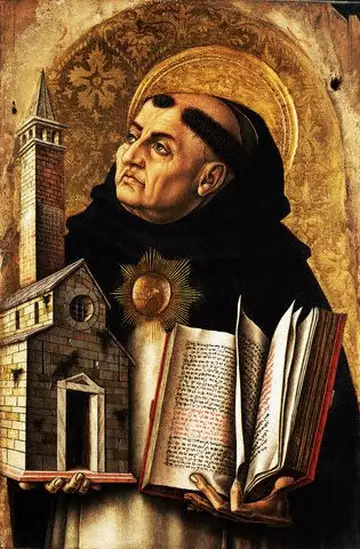 |
|
| Birth | 1225. Roccasecca, Italy |
| Death | March 7, 1274. Fossanova Abbey, Italy |
| Canonization | July 18, 1323 |
| Feast Day | |
| Patron | Catholic Schools, Universities, Students, Scholars, Philosophers, Theologians, Booksellers |
St. Thomas Aquinas (c. 1225–1274) was an Italian Dominican friar, philosopher, and theologian, considered one of history's most influential thinkers, known for synthesizing Aristotelian philosophy with Christian doctrine, bridging faith and reason, and authoring major works like the Summa Theologiae, becoming a saint and Doctor of the Church, and patron of Catholic education.
Personal Life
Thomas was born between 1224 and 1225 in the castle that his wealthy noble family owned at Roccasecca near Aquino, not far from the famous Abbey of Montecassino where his parents sent him to receive the first elements of his education. A few years later he moved to Naples, the capital of the Kingdom of Sicily, where Frederick II had founded a prestigious university. Here the thinking of the Greek philosopher Aristotle was taught without the limitations imposed elsewhere. The young Thomas was introduced to it and immediately perceived its great value. However, it was above all in those years that he spent in Naples that his Dominican vocation was born. Thomas was in fact attracted by the ideal of the Order recently founded by St Dominic. However, when he was clothed in the Dominican habit his family opposed this decision and he was obliged to leave the convent and spend some time at home.
In 1245, by which time he had come of age, he was able to continue on the path of his response to God's call. He was sent to Paris to study theology under the guidance of another Saint, Albert the Great, of whom I spoke not long ago. A true and deep friendship developed between Albert and Thomas. They learned to esteem and love each other to the point that Albert even wanted his disciple to follow him to Cologne, where he had been sent by the Superiors of the Order to found a theological studium. Thomas then once again came into contact with all Aristotle's works and his Arab commentators that Albert described and explained.
Because of his excellent intellectual gifts Thomas was summoned to Paris to be professor of theology on the Dominican chair. Here he began his literary production which continued until his death and has something miraculous about it: he commented on Sacred Scripture because the professor of theology was above all an interpreter of Scripture; and he commented on the writings of Aristotle, powerful systematic works, among which stands out his Summa Theologiae, treatises and discourses on various subjects. He was assisted in the composition of his writings by several secretaries, including his confrere, Reginald of Piperno, who followed him faithfully and to whom he was bound by a sincere brotherly friendship marked by great confidence and trust. This is a characteristic of Saints: they cultivate friendship because it is one of the noblest manifestations of the human heart and has something divine about it, just as Thomas himself explained in some of the Quaestiones of his Summa Theologiae. He writes in it: "it is evident that charity is the friendship of man for God" and for "all belonging to him" (Vol. II, q. 23, a. 1).
He did not stay long or permanently in Paris. In 1259 he took part in the General Chapter of the Dominicans in Valenciennes where he was a member of a commission that established the Order's programme of studies. Then from 1261 to 1265, Thomas was in Orvieto. Pope Urban IV, who held him in high esteem, commissioned him to compose liturgical texts for the Feast of Corpus Christi.
The last months of Thomas' earthly life remain surrounded by a particular, I would say, mysterious atmosphere. In December 1273, he summoned his friend and secretary Reginald to inform him of his decision to discontinue all work because he had realized, during the celebration of Mass subsequent to a supernatural revelation, that everything he had written until then "was worthless". This is a mysterious episode that helps us to understand not only Thomas' personal humility, but also the fact that, however lofty and pure it may be, all we manage to think and say about the faith is infinitely exceeded by God's greatness and beauty which will be fully revealed to us in Heaven. A few months later, more and more absorbed in thoughtful meditation, Thomas died while on his way to Lyons to take part in the Ecumenical Council convoked by Pope Gregory X. He died in the Cistercian Abbey of Fossanova, after receiving the Viaticum with deeply devout sentiments. [1]
Missions
Thomas Aquinas, at the school of Albert the Great, did something of fundamental importance for the history of philosophy and theology, I would say for the history of culture: he made a thorough study of Aristotle and his interpreters, obtaining for himself new Latin translations of the original Greek texts. Consequently he no longer relied solely on the Arab commentators but was able to read the original texts for himself. He commented on most of the Aristotelian opus, distinguishing between what was valid and was dubious or to be completely rejected, showing its consonance with the events of the Christian Revelation and drawing abundantly and perceptively from Aristotle's thought in the explanation of the theological texts he was uniting. In short, Thomas Aquinas showed that a natural harmony exists between Christian faith and reason. And this was the great achievement of Thomas who, at that time of clashes between two cultures that time when it seemed that faith would have to give in to reason showed that they go hand in hand, that insofar as reason appeared incompatible with faith it was not reason, and so what appeared to be faith was not faith, since it was in opposition to true rationality; thus he created a new synthesis which formed the culture of the centuries to come.
In 1269 Thomas was recalled to Paris for a second cycle of lectures. His students understandably were enthusiastic about his lessons. One of his former pupils declared that a vast multitude of students took Thomas' courses, so many that the halls could barely accommodate them; and this student added, making a personal comment, that "listening to him brought him deep happiness". Thomas' interpretation of Aristotle was not accepted by all, but even his adversaries in the academic field, such as Godfrey of Fontaines, for example, admitted that the teaching of Friar Thomas was superior to others for its usefulness and value and served to correct that of all the other masters. Perhaps also in order to distance him from the lively discussions that were going on, his Superiors sent him once again to Naples to be available to King Charles i who was planning to reorganize university studies.
In addition to study and teaching, Thomas also dedicated himself to preaching to the people. And the people too came willingly to hear him. I would say that it is truly a great grace when theologians are able to speak to the faithful with simplicity and fervour. The ministry of preaching, moreover, helps theology scholars themselves to have a healthy pastoral realism and enriches their research with lively incentives. [1]
Legacy
The life and teaching of St Thomas Aquinas could be summed up in an episode passed down by his ancient biographers. While, as was his wont, the Saint was praying before the Crucifix in the early morning in the chapel of St Nicholas in Naples, Domenico da Caserta, the church sacristan, overheard a conversation. Thomas was anxiously asking whether what he had written on the mysteries of the Christian faith was correct. And the Crucified One answered him: "You have spoken well of me, Thomas. What is your reward to be?". And the answer Thomas gave him was what we too, friends and disciples of Jesus, always want to tell him: "Nothing but Yourself, Lord!" (ibid., p. 320). [1]
In a letter written in Latin, Pope Francis has recalled the legacy of Saint Thomas Aquinas, describing him as "a man of the Church," priest and doctor who shared his "great spiritual and human wisdom" through prayers and writings. Released on 11 July, the letter announces the appointment of Cardinal Marcello Semeraro, prefect of the Dicastery for the Causes of Saints, as the Pope's special envoy to the celebration of the 700th anniversary of the canonization of Thomas Aquinas to be marked on 18 July at the Abbey of Fossanova, in the town of Priverno, in central Italy.
"Never having an air of superiority from his knowledge, but always edified by charity," the Dominican friar whom contemporaries already called the "Angelic Doctor" was "full of astonishing culture," the Pope points out in the letter, which bears the date 30 June and signature at Saint John Lateran. "He wrote many works and taught countless subjects, and was well qualified in the philosophical and theological disciplines. He manifested righteous intelligence and lucidity, and while reverently investigating the divine mysteries with reason, he contemplated them with fervent faith." [2]